When I first got my diagnosis, I did what everyone does. I panicked, went to Amazon, and typed “Fatty Liver Cure” into the search bar.
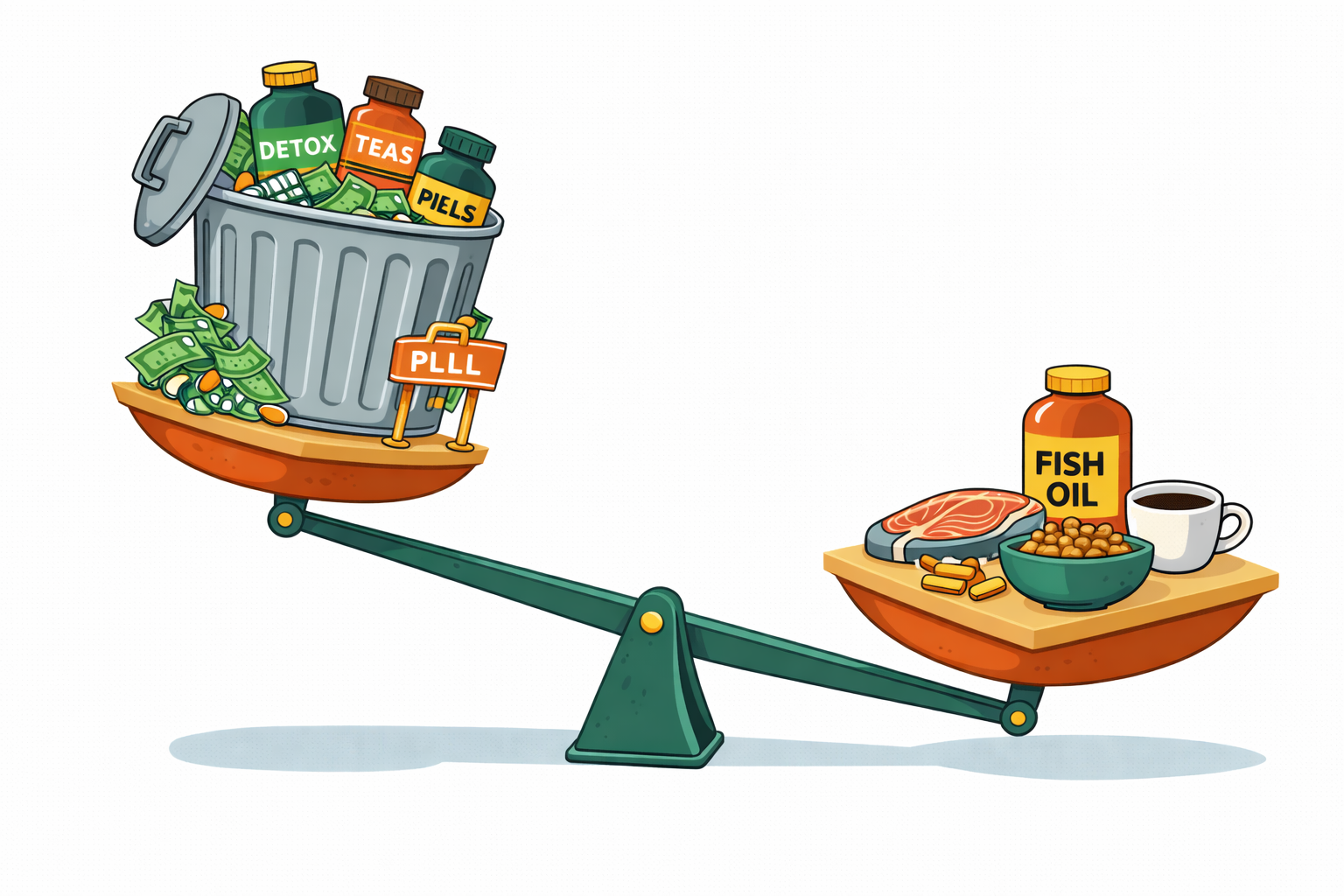
I was immediately bombarded with bottles promising miracles. “Liver Detox,” “Hepagard,” “DOSE.” They all had 5-star reviews and DOSE even cost $99 for three pints!
I almost bought them. I wanted a lifeline. I wanted a pill to scrub the fat out of my organ so I could go back to eating normal lunches.
But then I stopped panicking and started looking at the data. I realized that the entire “Liver Detox” industry is built on a misunderstanding of biology.
The Myth of the “Dirty Filter”
We tend to think of the liver like a lint trap in a dryer or an air filter in a car. We think it gets “dirty” and needs a special brush (milk thistle or dandelion root) to scrub it clean.
The “filter” analogy fails here. A dirty filter needs scrubbing, but a fatty liver just needs a break. The organ is overwhelmed by energy. It has converted too much incoming fructose into fat and has nowhere to put it. This is an overflow problem, not a hygiene problem.
You cannot “un-clog” an energy surplus with a pill.
You cannot scrub away visceral fat with tea.
The only way to unclog the liver is to stop the inflow (cut the fructose) and build a bigger drain (build muscle).
In fact, many “herbal blends” are dangerous. There are documented cases of people taking concentrated Green Tea Extract (EGCG) or Ayurvedic herbs and actually causing acute liver injury.
The irony is tragic: trying to heal the liver and ending up destroying it.
So, I developed a simple rule: If I can eat it, I won’t take a pill for it.
The “Food First” Approach
Before I look at any bottle, I look at my plate. There are compounds that help the liver, but I get them from the source.
- Turmeric (Curcumin)
Curcumin is a powerful anti-inflammatory. But instead of taking a concentrated pill (which can have low bioavailability), I just add turmeric and black pepper to my eggs in the morning. The black pepper contains piperine, which boosts absorption by 2000%. It’s cheap, tasty, and safe. - Coffee and Green Tea (Decaf counts!)
Data consistently shows that coffee can reduce liver stiffness and fibrosis.
I try to drink 16 oz or more coffee or green tea per day. However, because of my heart palpitations (PVCs), I have to be careful with caffeine. The good news is that studies show Decaf still offers liver protection thanks to other compounds like chlorogenic acid. So whether you drink it high-octane or unleaded, just drink it black.
The 2 Supplements I Actually Take
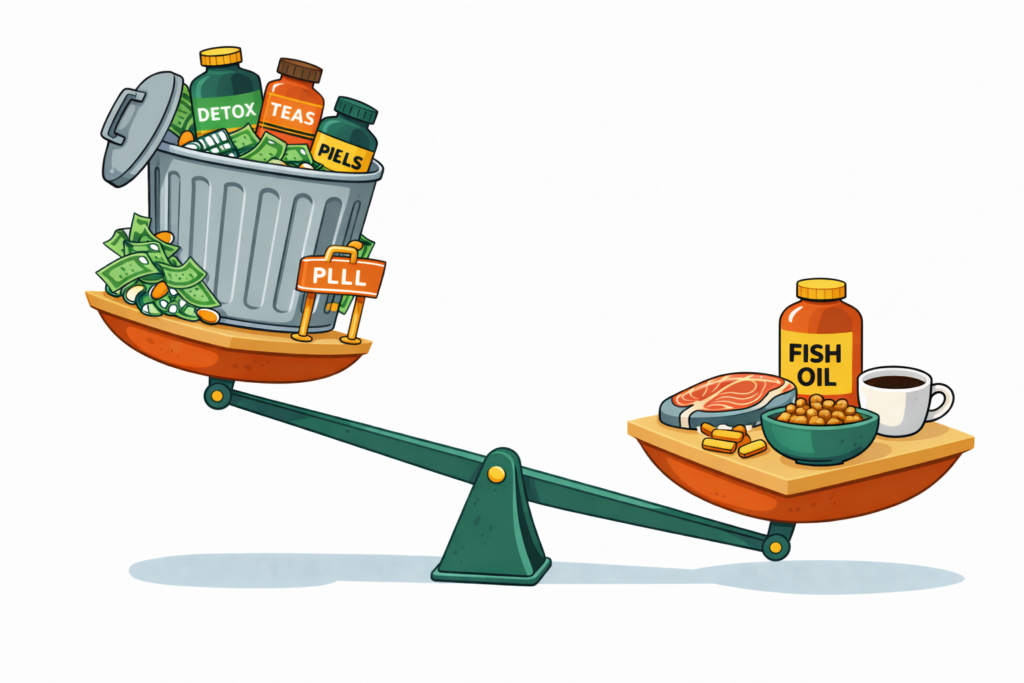
I only use supplements to fill a specific gap that my diet can’t cover. I don’t use them to “fix” my liver; I use them to fix a deficiency.
- Omega-3 Fish Oil
- The Why: Omega-3 fatty acids are proven to help lower triglycerides and reduce liver fat.
- The Gap: I should be eating salmon 3 times a week. The reality? My wife can’t stand the smell of it cooking. I’m lucky if I get salmon 2 to 4 times a month.
- The Fix: I supplement with Sports Research Omega-3 Fish Oil. I also try to regularly consume flaxseed and walnuts for the plant-based ALAs, but the fish oil ensures I get the potent EPA/DHA my liver needs.
- Magnesium
- The Why: I suffer from PVCs (premature ventricular contractions), which are heart palpitations that get worse with stress and poor sleep. Poor sleep raises cortisol, which prevents the liver from healing.
- The Gap: It is hard to hit 400mg of Magnesium purely through food every single day.
- The Fix: I take Doublewood Supplements Mag-8 or Magnesium Taurate.
- The “Blind Dosing” Warning: I used to blindly take 400mg a day on top of my diet. I was getting close to 800mg total, and it actually made my PVCs worse.
Now, I use my tracking app (Cronometer). I check how much magnesium I got from food (usually from spinach, nuts, etc.). If I hit 200mg from food, I only take 200mg from the pill to get me to the 400mg mark. Test, don’t guess.
The “Caution” List (Vitamin E & D)
You will hear a lot about these two vitamins in liver forums. Here is my experience.
Vitamin E
The PIVENS trial showed that Vitamin E can help non-diabetics with fatty liver. However, high-dose Vitamin E supplementation has been linked to increased prostate cancer risk in some studies. I decided the risk wasn’t worth it. I get my Vitamin E from almonds, spinach, and sunflower seeds.
Vitamin D
I was previously on a very high dose of Vitamin D for years because I was told “everyone is deficient.” I didn’t check my labs. It turned out I drove my calcium levels too high (Hypercalcemia).
I stopped the high dose. Now, I only take it if my bloodwork says I’m low, and I stick to smaller doses.
Conclusion: Don’t Major in the Minors
Supplements are the last 2% of the solution. Diet, sleep, and resistance training are the 98%.
I see people spending $100 a month on “Liver Detox” pills while still eating processed food. That is like trying to put out a forest fire with a squirt gun while someone is pouring gasoline on the trees.
Save your money. Spend that $100 on high-quality groceries instead.
If you want to see what I spend my money on at the grocery store, grab my free grocery system.