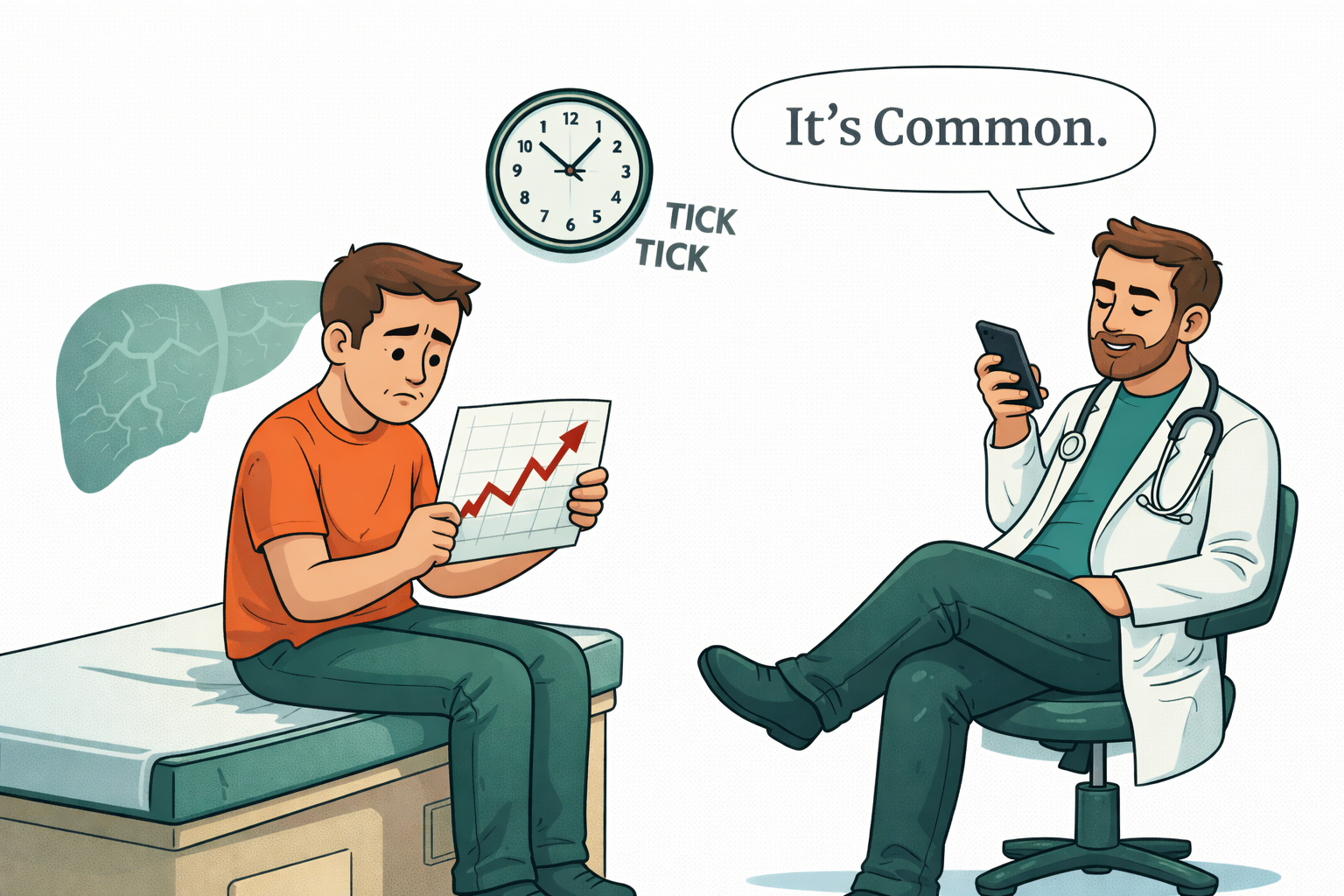
“My Mayo Clinic hepatologist told me not to worry about it.”
I read that comment on Reddit recently and my jaw hit the floor. This wasn’t a general practitioner at a strip mall clinic. This was a specialist at one of the best hospitals in the world telling a patient to ignore a progressive metabolic disease.
If you have been diagnosed with Fatty Liver (MASLD/MASH), especially if you are at a normal BMI, you have likely heard a version of this.
- “It’s very common.”
- “We’ll keep an eye on it.”
- “Just eat better and lose some weight.”
The medical system treats early-stage fatty liver with a casual shrug. They view it as a benign side effect of modern life.
But “common” does not mean “benign.”
High blood pressure is common. Cavities are common. We treat those immediately because we know what happens if we don’t. Yet with the liver, the standard of care seems to be “Wait and See.”
As a patient, you need to understand why this happens so you can stop waiting and start acting.
The “Lean” Blindspot
If you are overweight, doctors see the problem immediately. If you are lean, they often invent reasons why you are fine.
I saw a story from a 23-year-old patient that terrified me. They had elevated enzymes at age 14. The doctor blamed “exam stress.” Years later, another doctor saw the elevated numbers and blamed it on “drinking too much green tea.”
Why? Because the patient didn’t look sick.
By the time this patient finally pushed for a FibroScan at age 23, they had Stage 2 fibrosis.
If you look healthy on the outside, the medical community has a blindspot the size of a truck. They will rationalize your bloodwork away as a lab error, stress, or supplements rather than admitting you have a metabolic problem.
The Silent Killer
The main reason the “Wait and See” approach is so dangerous is that the liver suffers in silence.
Unlike your stomach or your joints, the liver has almost no pain receptors. You usually don’t feel “sick” until the liver is enlarged enough to stretch the capsule around it (hepatomegaly) or you have advanced to cirrhosis.
A nurse weighed in on the discussion with a chilling reality: “In my experience in medicine, if you don’t see it, you don’t care. Most patients will keep going till death if they were told nothing.”
Another patient mentioned they were diagnosed 20 years ago and given no advice other than “lose weight.” They felt fine for two decades until a scan showed cirrhosis.
You don’t wait for your car engine to seize before you change the oil. You cannot wait for your liver to hurt before you change your diet.
“Just Lose Weight” is Lazy Advice
For the Lean/Normal BMI patient, the advice to “lose weight” is paralyzing.
When I was diagnosed, I was 160 lbs. If I lost 10% of my body weight, I would have looked emaciated. Because the standard advice didn’t apply to my body type, my instinct was to ignore it.
- “Well, I’m not fat, so I must be okay.”
- “The doctor said lose weight, but I don’t need to lose weight, so I guess I don’t need to do anything.”
This is how we lose years of intervention time.
We need to replace “Lose Weight” with “Fix Metabolic Dysfunction.” That is actionable. That applies to the 300lb patient and the 150lb patient. It means cutting fructose, increasing muscle mass, and fixing sleep.
Be Your Own Hepatologist
If your doctor tells you not to worry, politely ignore them.
One patient in the forum mentioned they finally had to self-pay for their own ultrasound and bloodwork because insurance wouldn’t cover it without a more “serious” diagnosis. They took ownership.
You have to do the same.
- Get the data: Ask for the full panel (AST, ALT, GGT, Ferritin, Lipid Panel).
- Track the trends: Don’t rely on the doctor to remember what your numbers were last year. Put them in a spreadsheet. Watch the trend line.
- Ignore “Normal”: The reference range for ALT often goes up to 40 or 50. This is based on a sick population. Aim for “Optimal” (usually under 30 for men, under 20 for women).
Conclusion
Nobody cares about your body, your liver, as much as you do. The medical system is built to treat illness, not prevent it. If you wait for them to sound the alarm, the house might already be burned down.
Don’t wait for a diagnosis code. Start making changes today.
Step 1 is controlling what goes into your cart.