The Healthy Breakfast and Lunch that Made Me Sick
Growing up, a typical day would look like the following:
- Breakfast: Orange Juice and Quaker instant oatmeal (banana flavor was my favorite).
- Lunch: Peanut butter and Jelly on white bread, a banana, and a fruit-on-the-bottom yogurt.
- Dinner: Protein, carb, and green veggie + Dessert.
I thought I was eating somewhat healthy. The food pyramid told me fruit was good for me and yogurt is supposed to have good probiotics. I had veggies at dinner. Oatmeal is good for your heart.
I mostly stayed away from fast food and didn’t eat a bunch of candy, just some cookies and ice cream here and there.
The irony is that I was not eating healthy at all.
While I wasn’t eating out, I was eating “fast foods.” I mean foods that are metabolized super fast in the body. Instant oatmeal has a bunch of added sugar and has been processed down so much that it is quickly broken down. This increases the glycemic impact, causing a rapid blood sugar spike. This is also true for processed white bread, the jelly, and even the ripe banana I was eating (lots of fructose with minimal fiber).
Then there was the juice.
Juice is made up mostly of sugar in the form of fructose. Everyone knows the evils of High Fructose Corn Syrup, but it’s not the “syrup” part in processed foods that is the problem. It’s the fructose itself.
Glucose and Fructose are Not the Same
Glucose is the good kind of sugar. Every cell in your body uses it: your brain, heart, and muscles. When you eat a carbohydrate like potatoes or whole wheat bread, the starch gets converted to glucose and used to fuel your body.
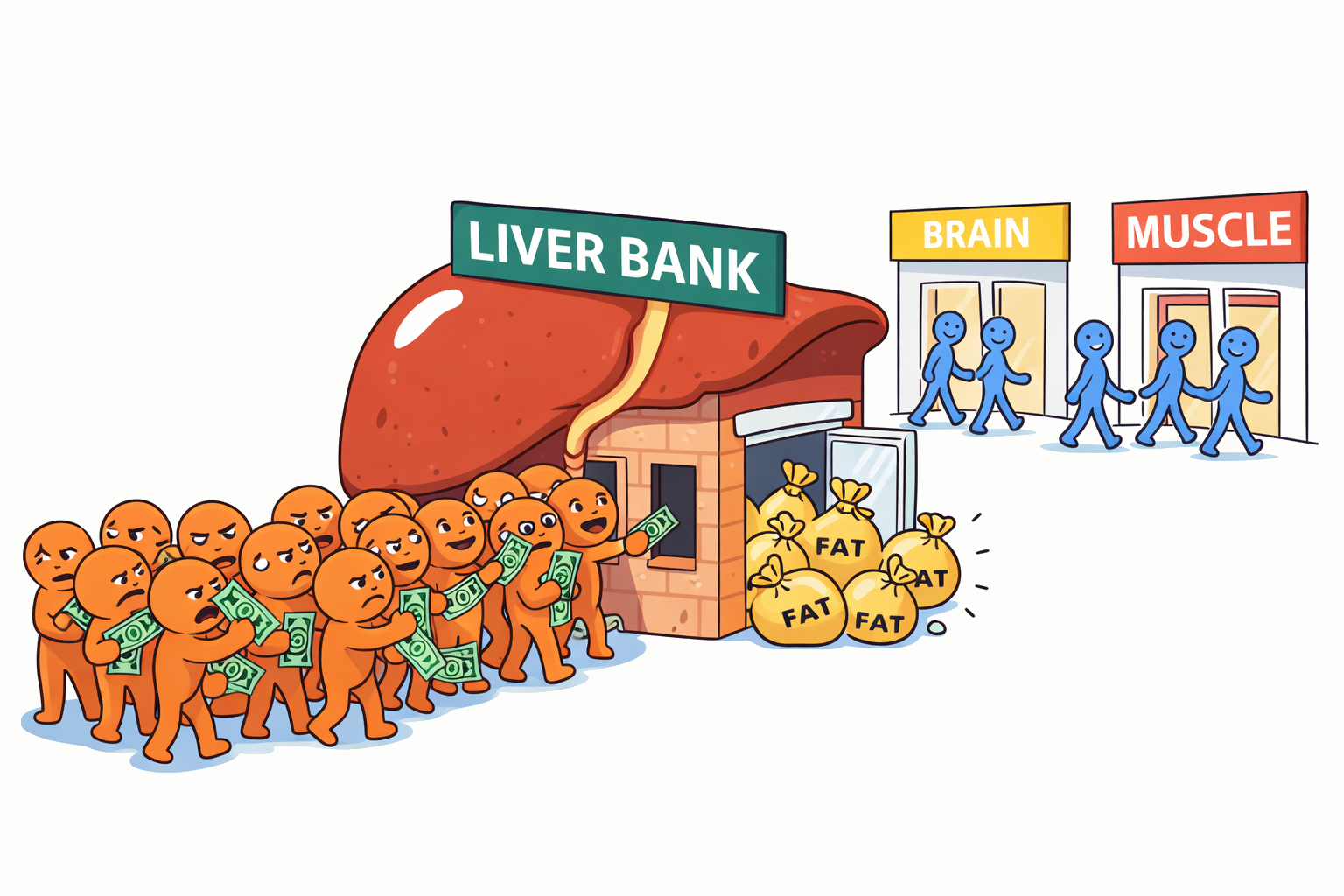
Think of it as the universal currency. You can take glucose to the brain store and buy some deep thoughts. You can take glucose to the heart store and buy some extra fast pumping for your cardio workout.
When you consume fructose, almost all of it goes into your liver to be processed. If there is too much of it for the liver to handle, it stores it as fat. In currency terms, fructose is foreign currency and it can only be exchanged at one bank in the body: the Liver. If there is a long line at the Liver Exchange Bank, you are sent to the waiting room (fat).
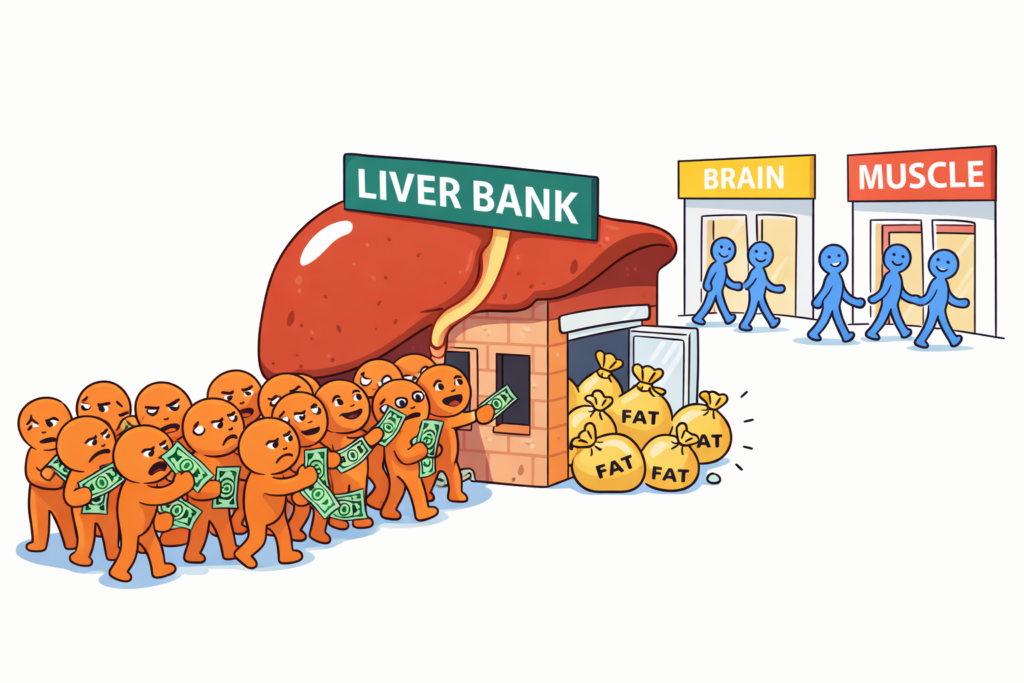
While the conversion of excess energy into fatty acids (called de novo lipogenesis) is an important part of your body’s energy balancing system, if too much is happening in the Liver, then you end up with fatty liver.
This is why fructose is so dangerous. Excess fructose creates new fat in the liver. This happens whether you are skinny or obese.
The “Natural Trap”
Look at all those TikTok or Instagram reels featuring a “healthier” version of a standard dessert. They proceed to use agave, maple syrup, honey, or dates to replace the sweetness of table sugar in the original recipe.
- Agave: Between 70% and 90% fructose.
- Maple Syrup: Essentially watered down table sugar.
- Honey: Slightly better at ~40% fructose and ~30% glucose.
- Dates: Around ~32% fructose and ~36% glucose.
So yes, dates and honey are slightly better for the lean fatty liver person, as long as you aren’t eating more of them than you would a standard dessert. You have to exercise extreme moderation.
Why is Whole Fruit Different?
Whole fruit is different from dried fruits or juice. Whole fruit has fiber and water. This slows down the digestion of the sugars in your body, reducing the size and speed of the line at the Liver Bank we mentioned earlier.
Eating a bunch of grapes will make you feel full and stop you from eating way sooner than raisins will. The net impact is less fructose in your system.
Juice is a pure fructose injection. It’s just as bad as a soda.
My Drop List (Foods I Removed)
- Juice: Gone, forever. There is no need for it in my liquid arsenal.
- Dried fruit: This might as well be candy with good PR. Craisins, Raisins, and Dates. Before I knew the science behind all this, I fell victim to the marketing PR and was consuming a mini Larabar after dinner every night. I thought it was the “healthy” dessert. I was wrong.
- Bananas/Grapes/Watermelon: Replaced with berries. Full disclosure: on days I swim in the morning, I eat a banana (on the greener side). I will immediately be burning that fuel in the pool.
- Agave/Maple Syrup and Honey: Replaced mostly with allulose, stevia, or monk fruit.
TL;DR – Respect the Dosage
We have all heard the phrase “It’s the dose, not the poison.” This statement is often followed up by telling someone about water. Water, if drank too much too fast, can kill you. We all know water is a good thing and necessary for our bodies.
This rings true for sugars and fructose. For the lucky group of us more predisposed to turn fructose into fat in our livers, we need to keep a keen eye on our dosage. Our window of tolerance is much smaller than our friends’.
I’m not going to lie, it sucks.
This is especially hard if you have been giving into a sweet tooth for almost four decades like I have. You need to remain diligent when grocery shopping to avoid stepping on one of these sugar bombs.
Thankfully, I have compiled a grocery system that helps prevent these missteps by removing those sugar bombs. Get yours now for free!