When I first saw “Fatty Liver” on my chart, my immediate instinct was to run. Literally.
I thought, “I have fat in my liver, so I need to burn calories. I need to run, bike, and sweat this out.”
I see this reaction in almost everyone who gets diagnosed. We panic, buy a pair of running shoes, and try to cardio our way to health. While cardio is great for your heart, if you have Lean Fatty Liver, it is only half the solution.
In fact, if you just run without lifting weights, you might actually make the underlying metabolic problem worse.
For the “Skinny Fat” (TOFI) body type, the problem isn’t usually that we aren’t burning enough calories. The problem is that we have nowhere to put the energy we eat.
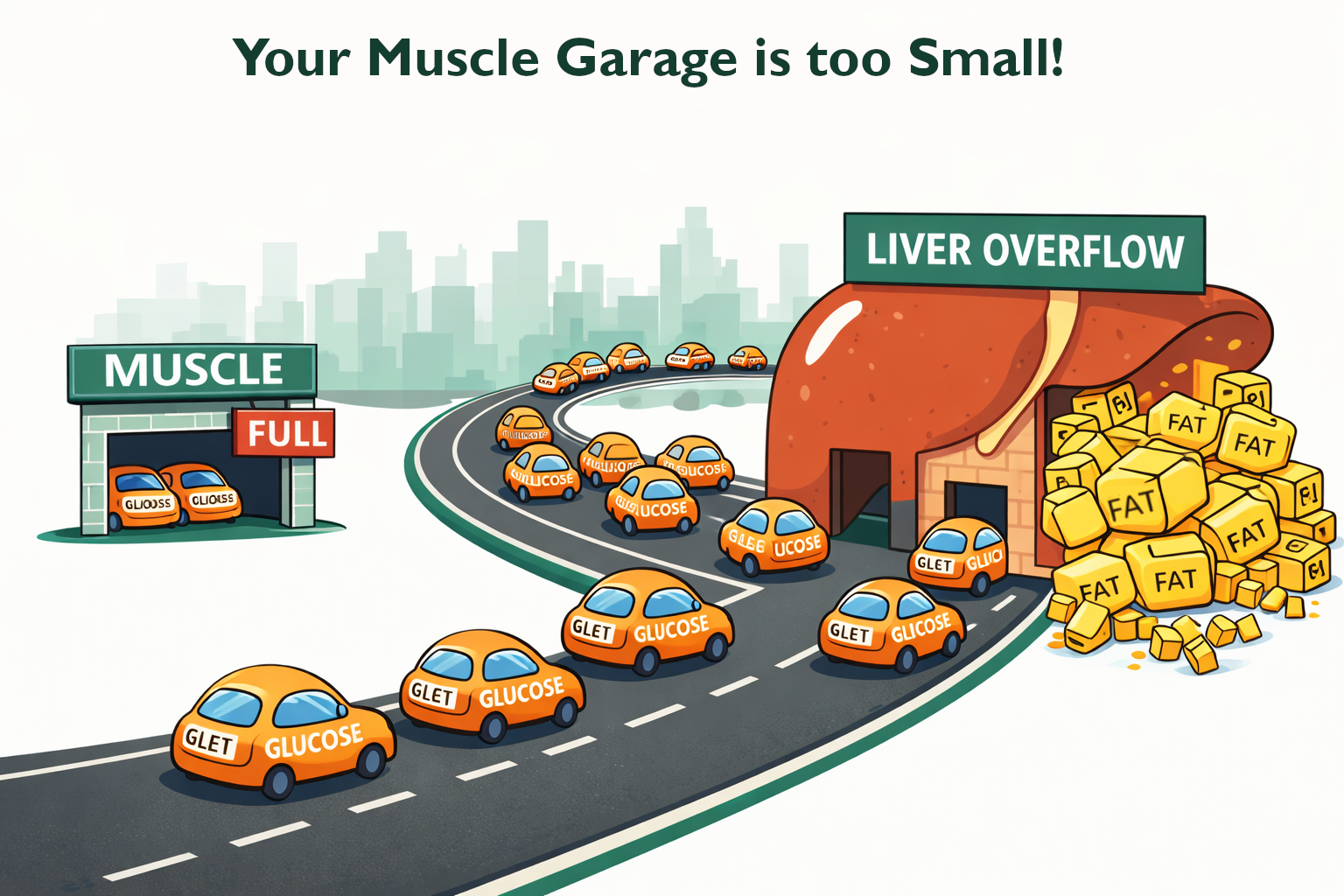
The Science: Your Muscles are a Parking Garage
To understand why I prioritize weights over cardio, you have to understand where sugar (glucose) goes when you eat it.
When you eat a potato or a piece of fruit, it breaks down into glucose and enters your bloodstream like cars entering a city. Your body has two main places to park those cars:
- Your Muscles (The Multi-Level Parking Garage).
- Your Liver (The Tiny Overflow Lot).
Skeletal muscle is responsible for about 75% of insulin-stimulated glucose disposal. In medical terms, this is called a “Glucose Sink.”
Here is the problem for the “Lean” patient:
Many lean MASLD individuals suffer from Sarcopenia (low muscle mass). We might look “normal” in clothes, but underneath, we don’t have enough muscle on our frame.
We have a parking problem.
Because we have low muscle mass, our main parking garage is tiny—maybe only one level instead of ten. When we eat a normal meal, that small garage fills up instantly.
Since the cars (glucose) can’t just stay on the highway (your blood), they get diverted to the only place left: The Liver.
But the liver isn’t designed for long-term parking. When it gets overwhelmed with traffic it can’t handle, it crushes those cars into cubes and stacks them in the corner. We call those cubes Triglycerides (Body Fat).
The Solution:
If you just do cardio, you are driving the cars around the block to burn gas. That helps a little.
But if you lift weights, you are building a new level on the parking garage.
By growing larger muscles, you physically increase the number of parking spots available for glucose. The more spots you have in your muscles, the fewer cars end up getting crushed and stored in your liver.
Cardio vs. Weights: The Verdict
I am not saying cardio is bad. I walk daily and swim. But I view them differently now.
- Cardio (Zone 2): This improves your engine. It helps your mitochondria burn fat more efficiently. It is great for general health and keeping visceral fat down.
- Weights (Hypertrophy): This builds the storage tank. By growing larger muscles, you physically increase the amount of glycogen (sugar) your body can store safely.
If you have a normal BMI but a fatty liver, Hypertrophy (Muscle Growth) may be your prescription. You need to earn your carbs.
A Warning: The “Gym Noise” False Positive
Before I share my routine, I need to share a massive lesson I learned the hard way.
Hard weightlifting spikes your liver enzymes.
When you lift heavy weights, you are creating micro-tears in your muscle fibers. That is how muscle grows. But when those fibers repair, they release enzymes into your blood—specifically AST and ALT.
These are the exact same enzymes doctors use to measure liver damage.
In November, I panicked because my AST/ALT numbers went up. I couldn’t figure out why until I looked at my calendar. I had done a heavy leg day 72 hours before my blood draw. My liver was fine; my muscles were just recovering.
The Rule: If you lift heavy, do not get bloodwork done for at least 7 days after your last workout. Otherwise, you risk a false positive that will scare the hell out of you.
My Simple “Lean Liver” Routine
I try to do this 3 days a week. The goal is to work and grow the biggest muscles in the body to increase muscle mass and enlarge that glucose “sink.”
If I can’t make it to the gym, that’s no excuse. I do most of these at home with a single kettlebell and a doorframe pull-up bar (got mine at Goodwill for $4).
The Workout:
Do each exercise 2-3 times for 8-12 reps. For bodyweight exercises, go until failure (until you can’t do another one with good form).
The Home Option
- Legs: Bulgarian Split Squats and Single-Leg Romanian Deadlifts. (These are humble, but they will torch your legs).
- Chest: Push-ups. I do tons of variations. I love using my kids’ play chairs to do deficit pushups for a deeper stretch.
- Back: Pull-ups. Change up grips (overhand, underand, wide grip)
- Shoulders: Lateral raises or Upright rows. I use one hand or both hands depending on my kettlebell weight.
- Core: Planks.
The Gym Option
- Legs: Barbell Squats or Leg Press, Barbell Deadlifts.
- Chest: Slight Incline Dumbbell Press.
- Back: Chest Assisted Rows.
- Shoulders: Arnold Press.
- Core: Weighted Sit-ups or Cable Woodchoppers.

Conclusion
You don’t need to become a bodybuilder. You just need to be harder to kill.
Every pound of muscle you build is a little bit of protection for your liver. It gives your metabolism a place to put dessert so it doesn’t end up as visceral fat.
Of course, you can’t build muscle without the raw materials. If you aren’t eating enough protein, all this lifting is a waste of time. Check my Grocery System to see the high-protein staples I keep in my fridge to support this growth.