When I was first diagnosed with Fatty Liver, I made a logical but incorrect assumption: I thought it was a disease of eating too much fat. My doctor if stated in my diagnosis appointment to “Eat a low-fat Mediterranean diet.” Which I now know is an oxymoronic statement as the Mediterranean diet is rich in healthy fats like avocados and olive oil.
Alas, my instinct at the time was to switch to low-fat yogurt and boneless skinless chicken breast. But as I dug into the science, I realized I was focusing on the wrong enemy. It’s not the dietary fat that is causing fatty liver, but rather a hormone signaling problem.
The hormone is Insulin, and the problem is Insulin Resistance. Understanding this one concept is the hidden key to reversing the disease.
The Science: Shouting in a Noisy Room
Let’s break this down with a simple analogy.
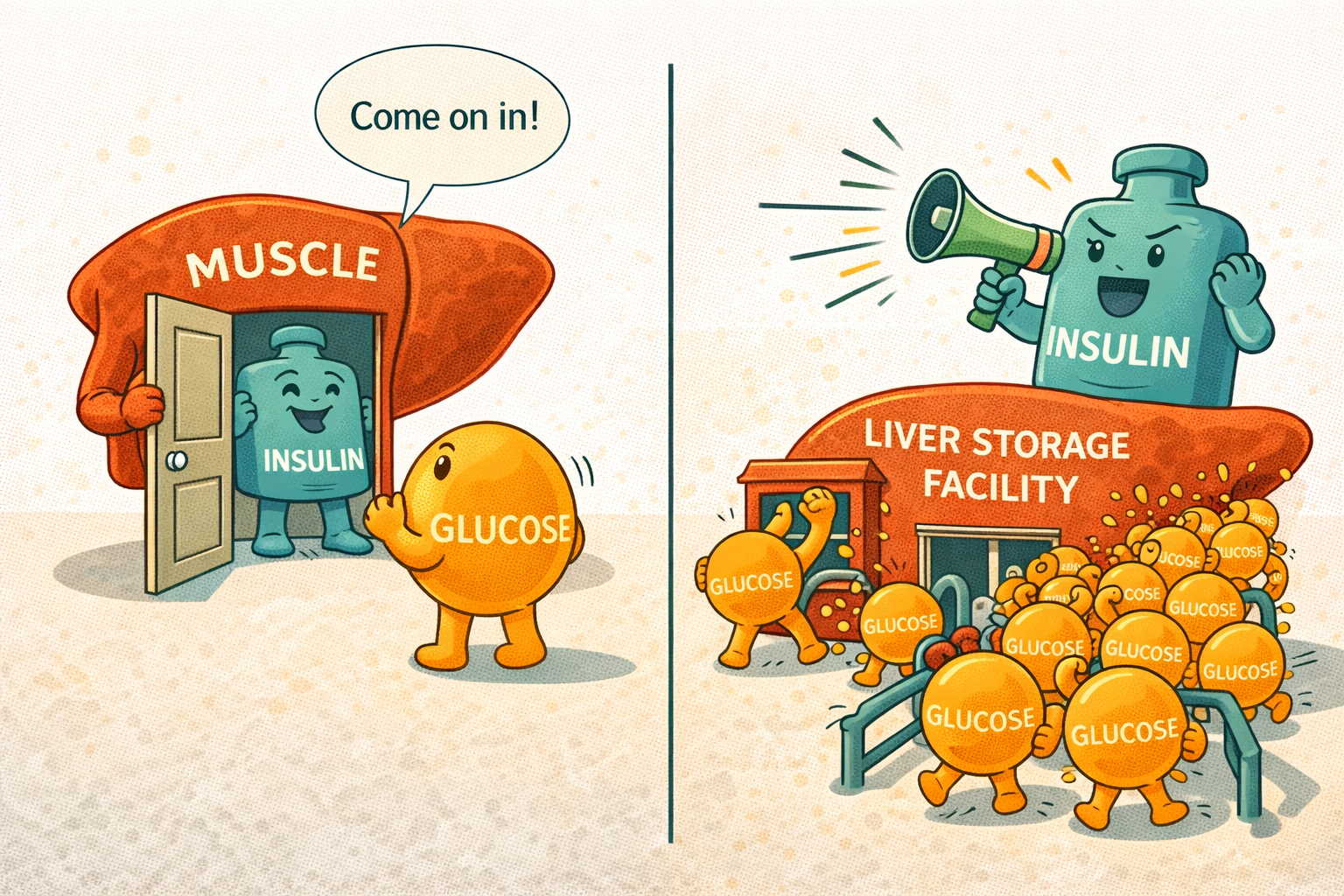
Imagine your muscle cells are houses, and glucose (sugar) is a guest waiting outside. Insulin is the person who knocks on the door and tells the muscle to let the guest in.
In a Healthy Body (A Quiet Room):
Insulin speaks in a normal voice. The muscle cell hears it, opens the door, and lets the glucose in to be used for energy. Blood sugar stays stable.
In an Insulin-Resistant Body (A Loud Party):
The muscle cell can’t hear the signal. The room has become too noisy due to things like:
- visceral fat
- sedentary lifestyle
- caloric surplus
- sleep disruption
- genetics
- refined carbohydrate excess
So insulin has to shout. Then it has to shout louder. Your pancreas keeps releasing more and more insulin just to get the same job done. Meanwhile, more and more glucose guests are piling up outside the house.
When too many guests are stuck outside, the body sends them somewhere else to deal with the overflow: the liver.
Think of the liver like a storage facility for the neighborhood. When it sees a crowd of extra glucose that the muscles aren’t letting in, it starts converting those extra guests into fat for storage.
All of this constant insulin “shouting” is called hyperinsulinemia (chronically high insulin levels), and it becomes a major driver of fatty liver because it tells the liver to turn excess glucose into fat faster than it can burn or ship it back out.
The Double Whammy: How High Insulin Destroys the Liver
The muscles stopped accepting guests, so the liver had to start storing them
- The Overflow (De Novo Lipogenesis)
When muscle cells become insulin resistant, they don’t take in glucose as efficiently. Blood sugar rises, and insulin levels rise along with it.
The liver is constantly monitoring the bloodstream, and when it sees high glucose and high insulin, it switches into storage mode.
First, it stores some glucose as glycogen. But glycogen storage is limited. Once those stores are full, the liver starts converting excess carbohydrate into fat through a process called De Novo Lipogenesis (which simply means “making new fat”).
That fat can be packaged and exported into the bloodstream, but some of it stays behind in the liver.
This is why fatty liver can develop even in people who eat very little dietary fat. If carbohydrate intake is consistently high and insulin levels stay elevated, the liver can manufacture its own fat from sugars and refined carbohydrates.
2. The Production Problem (Fat Made Faster Than It Leaves)
This is the part most people miss.
Insulin is a powerful metabolic signal that tells your body: “Energy is plentiful—store it.”
When insulin stays chronically elevated:
- The liver is stimulated to produce more fat
- Fat burning is suppressed
- And fat cells (adipose tissue) can begin releasing their stored fatty acids into the bloodstream, which flow directly to the liver and add to the burden.
The liver does try to ship fat out by packaging it into particles called VLDL, but if fat production and incoming fatty acids keep outpacing export and burning, fat starts accumulating inside the liver itself.
In simple terms
fatty liver develops when fat coming into the liver and being produced there exceeds the liver’s ability to burn it or ship it back out into circulation.
Over time, that imbalance leads to fat building up inside liver cells.
Do You Have Insulin Resistance? (The Home-Check)
You don’t need a fancy test. Your body gives you clues.
- A “spare tire” of belly fat, even if you are otherwise lean (this is visceral fat). When first diagnosed, I had extra fat around the waist of my pants
- Skin tags or dark patches of skin on your neck/armpits (acanthosis nigricans).
- Feeling sleepy and needing a nap an hour after a carb-heavy meal. THIS WAS ME 100% I used to joke about food coma’s but now I know why they happened. They were also happening more frequently up to my fatty liver diagnosis.
The best clue, however, is in your bloodwork. As I explained in my post on reading bloodwork, the Triglyceride/HDL Ratio is a fantastic tool for predicting insulin resistance. Take your Triglycerides number and divide it by your HDL number.
- Ideal: Below 1.0
- Insulin Sensitive: 1.0 – 3.0
- High Risk of IR: Above 3.0
How to Fix Insulin Resistance
You can’t “cure” Insulin Resistance with a pill. You have to fix the signaling or shut down the party.
- Turn Down the Noise (Carb Management):
You don’t have to go full Keto (or carnivore diet), but you do have to manage the carbohydrate load. Replace “fast carbs” (white bread, sugar) with “slow carbs” that come with fiber (vegetables, legumes, whole fruit).
This doesn’t mean you can never have a “fast” carb again. A balanced meal can act as a buffer. If you ensure your plate is loaded with Fiber (from vegetables/beans), Fat (from avocado/nuts/olive oil), and Protein (from eggs/beans/meat/fish), you can handle a small portion of a faster carb like potatoes or white rice. Pro Tip: Eating your carbs at the end of the meal, after the fiber and protein, has been shown to significantly blunt the blood sugar spike.
Want to dive further into how foods or the order in which you eat affect your blood sugar? I highly recommended checking out this guy on youtube. He wears a continuous glucose monitor and eats different foods to see how they affect him.
- Build More “Listeners” (Muscle):
The more muscle you have, the more “doors” and receivers are available to accept glucose. Think of it like notifications on your phone, you’re much more likely to receive the messages (for energy use). This is why resistance training is non-negotiable. Building your “Glucose Sink” makes your body more sensitive to insulin’s signal. - Give Your Body a Break (Meal Timing):
If you are snacking all day long, your insulin is always elevated. Stick to distinct, balanced, meals and give your body 4-5 hours in between to let insulin levels fall. This “unlocks” fat burning.
Conclusion
Stop thinking about your fatty liver as a fat storage disease. Start thinking of it as a communication breakdown.
Your goal is to restore the conversation between your hormones and your cells. When you do that, the liver naturally cleans itself out.
This is why my free grocery system focuses so heavily on protein and fiber—they are the tools that quiet the noise and let your body hear the signal again.