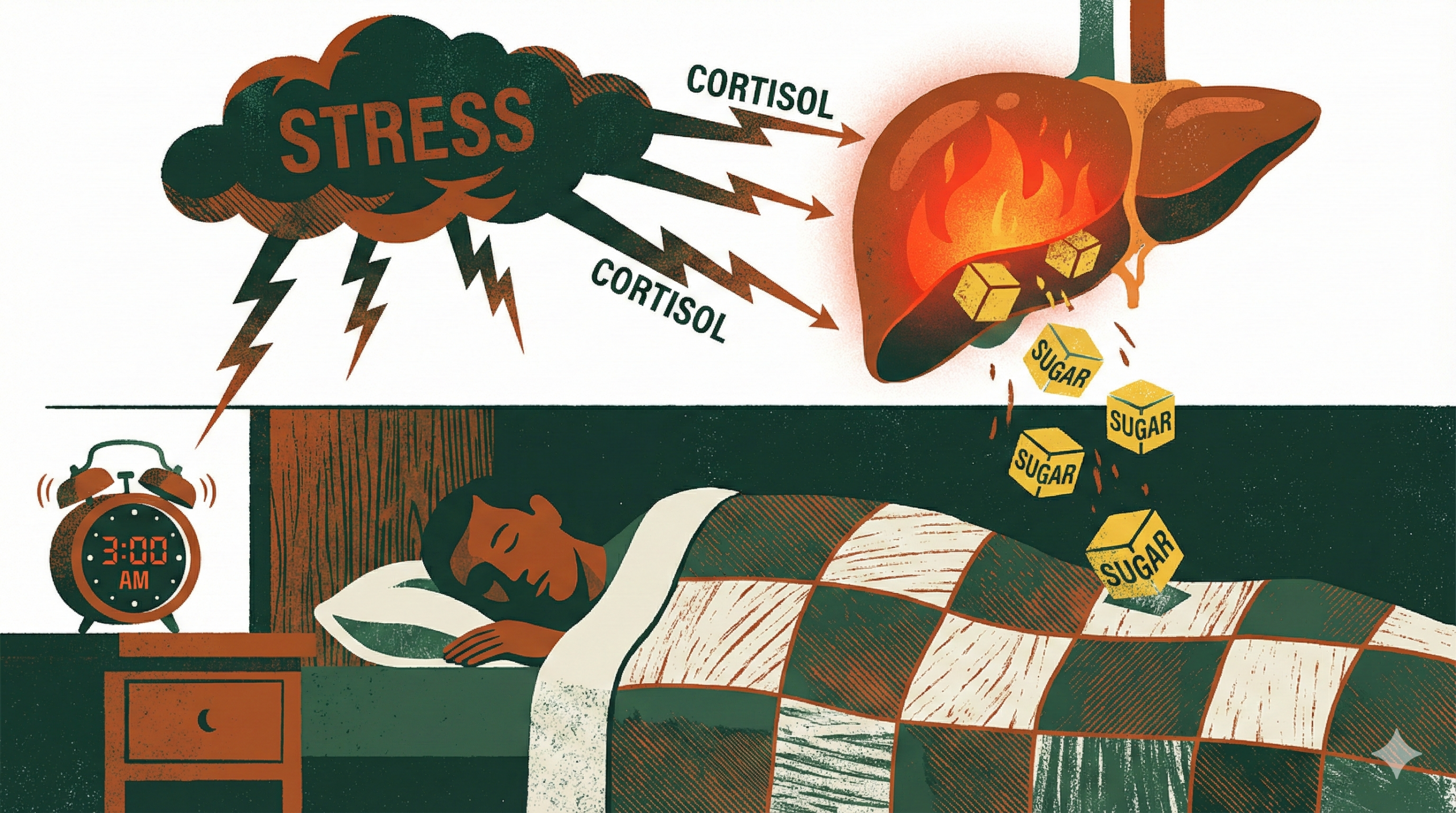
I was doing everything right. My diet was high protein. My added sugar intake was near zero. I was lifting weights.
But my numbers were moving slower than I wanted.
When I looked at my tracking spreadsheet, something was missing. It was something that can’t be validated by a test, but my body knew what was holding me back…sleep, or rather, how I wasn’t sleeping.
If you are a parent, especially a parent of neurodivergent children like I am, you know the drill. My Garmin watch says I was “in bed” for 7 to 8 hours. But being in bed and being in a state of restorative rest are two different things.
At least 50% of my nights are interrupted. A child waking up, a sensory meltdown at 2 AM, or just the hyper-vigilance of waiting for the next shoe to drop.
I realized I was living in a state of chronic, low-grade fight-or-flight. My body was flooded with Cortisol. And as I dug into the research, I found out that Cortisol is arguably just as bad for the liver as Fructose.
The Science: Why Stress Turns into Fat
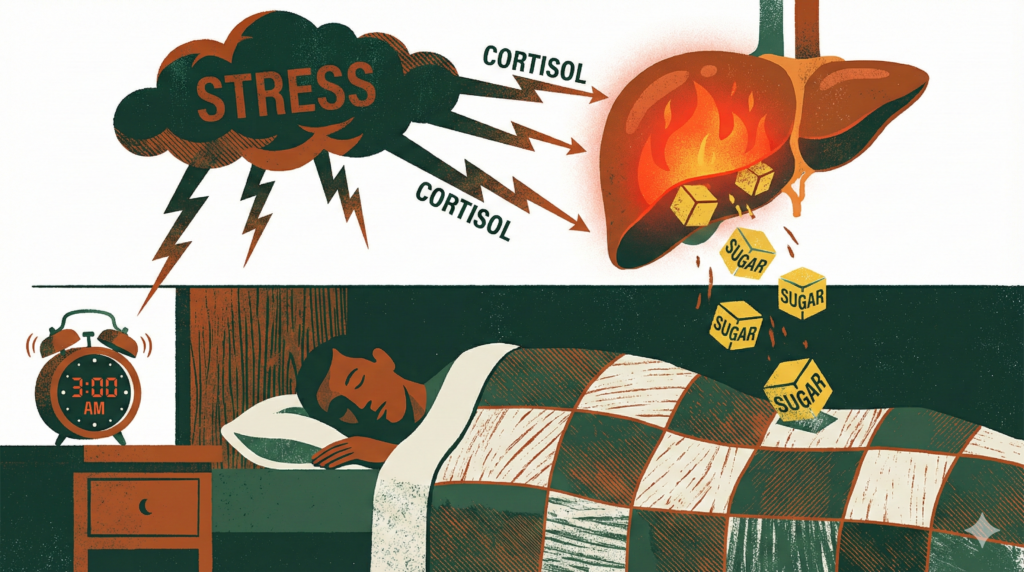
We think of stress as an emotional problem. The liver thinks of stress as a fuel problem.
When you are stressed (or sleep-deprived), your body releases Cortisol. This is the survival hormone designed to help you run away from a tiger.
Cortisol sends a specific command to the liver: “Dump sugar! We need energy now!”
Your liver responds by performing Gluconeogenesis, meaning it creates new glucose and dumps it into your bloodstream to fuel your escape.
Here is the problem:
There is no tiger. You are just stressed about work or dealing with a waking child. You aren’t running anywhere.
So, your blood sugar spikes, but you don’t burn it off. Your pancreas releases insulin to deal with the sugar. And what happens when you have high insulin and high blood sugar with nowhere to go?
The liver takes that sugar back and stores it as fat.
You can eat a perfect low-carb diet, but if your Cortisol is chronically high, your body is effectively making its own sugar from the inside out. You are fighting a war on two fronts.
The Cravings Loop (Why I Wanted Carbs)
This cortisol cycle didn’t just affect my liver; it hijacked my appetite.
I noticed that whenever my stress levels redlined, I wasn’t just tired, I was ravenous. And I didn’t crave chicken or broccoli. I craved easy energy. Cereal. Chips. Sweets.
This is an unfortunate failure of biology in the world we live in today.
When cortisol dumps that sugar into your blood, your insulin spikes to clear it out. Once the insulin does its job, your blood sugar crashes. That crash signals your brain that you are “starving” and need quick fuel immediately.
I often caved to that feeling. I would grab “extra carbs” to soothe the stress, thinking I just needed a snack. In reality, I was pouring gasoline on the fire. I was feeding a glucose spike that my stress hormones had already created.
The “Parenting Paradox”
This is the hardest part for the “Lean” fatty liver patient. We often don’t have the buffer of subcutaneous fat to absorb this hormonal chaos.
For me, the stress of raising two neurodivergent kids means my baseline alert level is always dialed up to an 8 out of 10. Even if I get “8 hours” of sleep, if those hours are fragmented, my Cortisol never fully dips to the baseline needed for deep repair.
If you wake up tired even after a full night in bed, your liver is likely feeling it too.
What Can We Actually Do?
I can’t just “decide” to have my kids sleep through the night. I can’t just “quit” the stress of parenting.
But I have learned to control the variables I can touch. Here is my protocol for managing the Cortisol Saboteur.
- The “Doom Scroll” vs. The “Comfort Show”
I used to try to follow the generic “No Screens” advice, but being neurodivergent myself, I found that sitting in silence actually made my brain louder.
I realized there is a huge difference between Active screen time and Passive screen time.
- The Phone (Active): Doom-scrolling social media gives me hits of dopamine and anxiety. It keeps my brain in “hunt” mode.
- The TV (Passive): Watching a familiar show is actually a regulator for me. It helps quiet the internal noise so I can drift off.
My Fix: I ban the phone 30 minutes before bed (or at least use the “Bedtime Mode” light filter), but I allow myself an episode of a comfort show to help my nervous system downregulate. Find what actually calms you, not just what the textbook says.
- Magnesium
I mentioned Magnesium in my supplement post, but it bears repeating here.
- Why: Magnesium helps lower cortisol and supports the nervous system.
- The Type: I specifically use Magnesium Taurate (For PVCs) or Magnesium Complex at night.. (Avoid Citrate unless you want a laxative effect).
- Morning Light (The Reset)
This sounds too simple to work, but it does. Getting bright natural light in your eyes within 20 minutes of waking up sets your circadian rhythm for the night.
- My Fix: My wife and I purchased one of those sunlight alarm clocks. It tells my body “The day has started,” which helps the Cortisol curve drop correctly later at night.
- Box Breathing (The Emergency Brake)
When I am lying in bed at 3 AM after dealing with a kid, my mind races. I use breathing excercises to manually shut down the stress response.
- The Method: Inhale for 4 seconds. Hold for 4. Exhale for 4. Hold for 4.
- It physically forces your nervous system out of “Fight or Flight” and back into “Rest and Digest.”
Conclusion
If your diet is perfect but your liver isn’t healing, stop looking at the food. Look at your stress.
You might not be able to fix your life circumstances overnight. But your sleep and rest overnight is a metabolic lever. Protect your sleep like you protect your diet. Your liver is counting on it.